
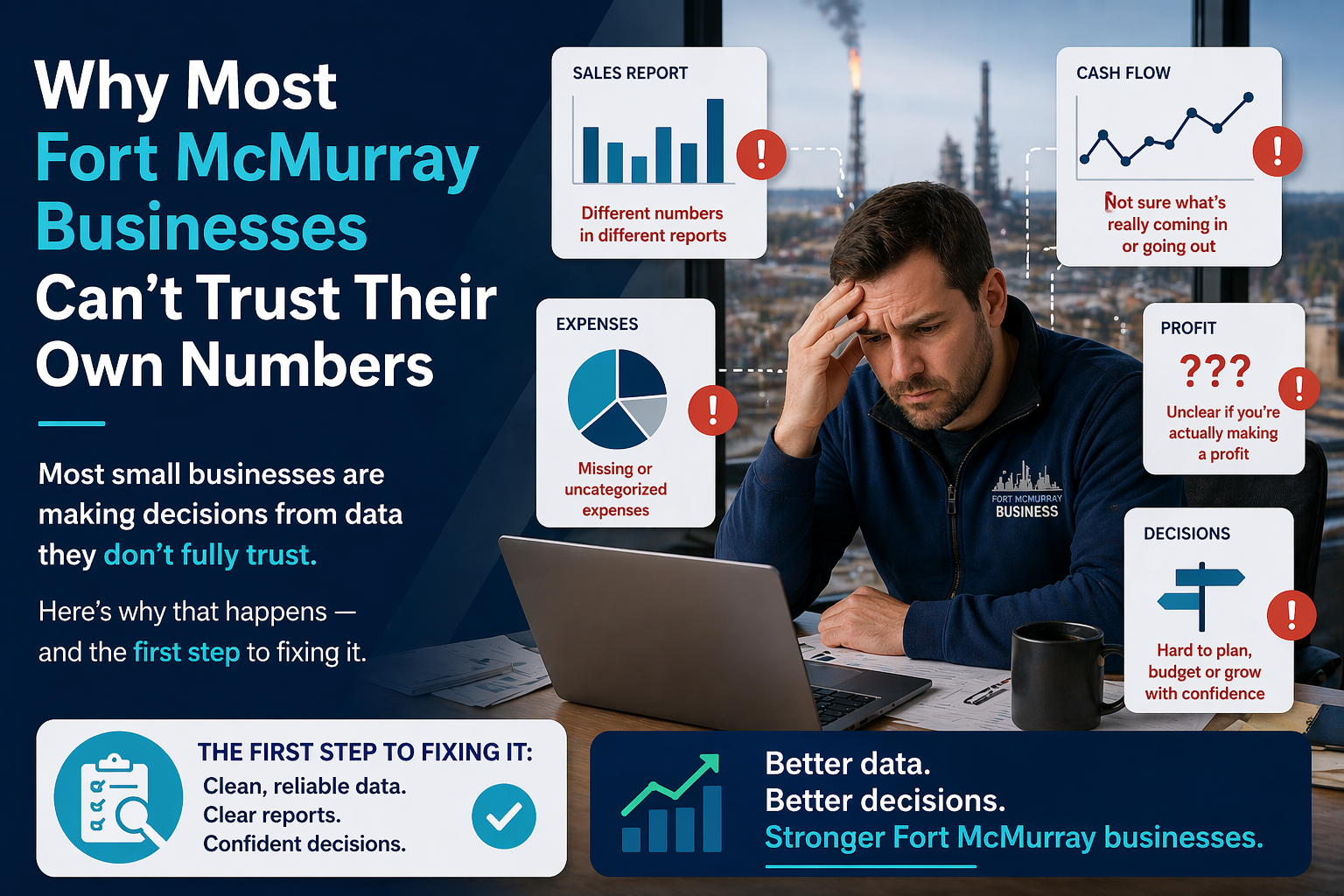
Ask a business owner in Fort McMurray how their numbers look, and you'll usually get one of two answers: "We're doing okay, I think" — or a long pause followed by "I should really look at that."
That hesitation is not laziness. It's not ignorance. It's the natural result of running a business where the data you have doesn't quite add up, and you've learned — over time — not to fully trust it.
This is more common than most people admit. And it quietly costs businesses money, time, and confidence every single week.
The Root Problem: Data Exists, But It's Not Usable
Most businesses in Wood Buffalo aren't short on data. They have QuickBooks records, spreadsheets, invoices, payroll files, job sheets, and client notes. The problem isn't that information doesn't exist — it's that it lives in five different places, none of which talk to each other.
When you need to answer "How profitable was last quarter?", you end up doing math in your head, pulling three spreadsheets, and arriving at a number you're not quite confident in. So you make a decision anyway, hoping it's roughly right.
"The problem isn't that the data is missing. It's that the data is scattered — and scattered data is almost as useless as no data at all."
Three Reasons This Happens Specifically in Fort McMurray
1. The boom-and-bust rhythm creates messy records
When work is flying in, tracking slips. When things slow down, you're focused on survival, not spreadsheets. Over time, your records end up with gaps, inconsistencies, and figures that don't reconcile. This is a pattern we see repeatedly with oil-sector contractors, trades businesses, and service companies across the region.
2. The workforce changes faster than the systems do
If a key employee leaves — the one who "knew how the spreadsheet worked" — that institutional knowledge walks out the door. What's left is a file no one fully understands, filled with formulas no one trusts, tracking metrics no one defined.
3. Software is adopted without structure
QuickBooks is powerful. Excel is powerful. But software doesn't fix process. If your chart of accounts was set up by someone who no longer works for you, or your expense categories were never clearly defined, the reports coming out of that system will always feel slightly off — because they are.
What "Untrusted Data" Actually Costs You
When you can't fully trust your numbers, you:
- Avoid raising prices because you're not sure if you're actually making money at current rates
- Miss grant and incentive opportunities because you can't produce the financial summaries required
- Struggle to get financing because your books don't tell a clear story
- Make staffing decisions based on gut feeling rather than actual capacity data
- Spend hours every month reconciling instead of running your business
None of these are dramatic failures. They're slow leaks — the kind that add up quietly over months and years.
The First Step Is Simpler Than You Think
The fix doesn't start with new software. It doesn't require a full audit. It starts with one question:
What is the one number that, if you could trust it completely, would change how you run your business?
For most businesses, it's profit margin per job, or monthly cash position, or labour cost as a percentage of revenue. Pick one. Just one. Then trace backwards: where does that number come from? What data feeds it? Where are the gaps?
That single exercise — taking one metric seriously — is how most businesses start getting their data under control. Not with a big system overhaul, but with a focused, honest look at one thing that matters.
At CommonGround, we start every engagement with exactly this kind of conversation. We call it a data audit — but it's really just a structured way of helping you see your own numbers clearly, often for the first time.
If any of this sounds familiar, the conversation is free and there's no pressure. Just an honest look at what's going on.
Does your business have a data problem you can't quite name?
We offer a free 20-minute conversation — no pitch, no pressure. Just an honest look at what's going on and whether we can help.
Book a free chat →